AGENTIC ENGINEERING CASE STUDY
How an ITA Group Engineering Team Became Agentic-First in Six Weeks
THE PROBLEM
Coding agents are changing how software gets built, but most teams haven't changed how they work. A Midwest engagement and loyalty leader set out to see what agentic delivery could do on real work.
In Stack Overflow's 2025 Developer Survey, 84% of developers said they use or plan to use AI tools in their development process, up from 76% the year before. Yet 46% said they don't trust the accuracy of those tools' output, up from 31%. Adoption is climbing faster than confidence.
THE OPPORTUNITY
THE OPPORTUNITY
ITA Group had a consequential business application that needed to ship quickly, and leadership wanted to see what agentic delivery could do on real work. They chose an engineering team that was skeptical of AI, and a live use case, as the proving ground.
THE SOLUTION
APPROACH
Lean TECHniques embedded two senior engineers alongside ITA Group's team for six weeks. Together they built out the time-sensitive application and put agentic engineering practices in place across the SDLC on Claude Code, coaching agentic-first methods along the way. This approach blended capacity uplift while building the capability internally to keep going. Before the engagement was over, other teams were already asking for the same support, and the client team's view of AI had shifted to optimism. ITA Group's engineers took it from there, authoring their own skills and extending the practices themselves.
THE IMPACT
THE RESULTS
• 99%+ of shipped code AI-generated. About 100,000 lines were delivered across the engagement, all reviewed by AI and a human before merge.
• 2x throughput with the same team and no quality concessions.
• 10x improvement in quality, measured by DORA change failure rate.
• No automated test suite to ~98% coverage, with 5,000+ tests.
• Most stories completed in under 15 minutes. The largest refactors ran under 90 minutes of autonomous agent time.
• Requirements throughput kept pace. The BA went from readying 15–20 stories per two-week sprint to 50–60 per week.
• Fewer defects reaching QA. QA typically found 2–3 issues per story. On this agentic-first team, they rarely found any.
• Deep adoption. Engineers began authoring their own custom skills and running up to five concurrent agent sessions.
• Usage outgrew the original plan. Mid-engagement, developers running concurrent agent sessions began hitting daily ceilings, so the team upgraded to unlimited Claude Code.
THE PROBLEM
HOW THIS COMPARES TO INDUSTRY BENCHMARKS
Most organizations have coding assistants in the hands of their developers. What the majority are still working toward, though, is real, measurable gains in throughput and quality – without losing control of what ships.
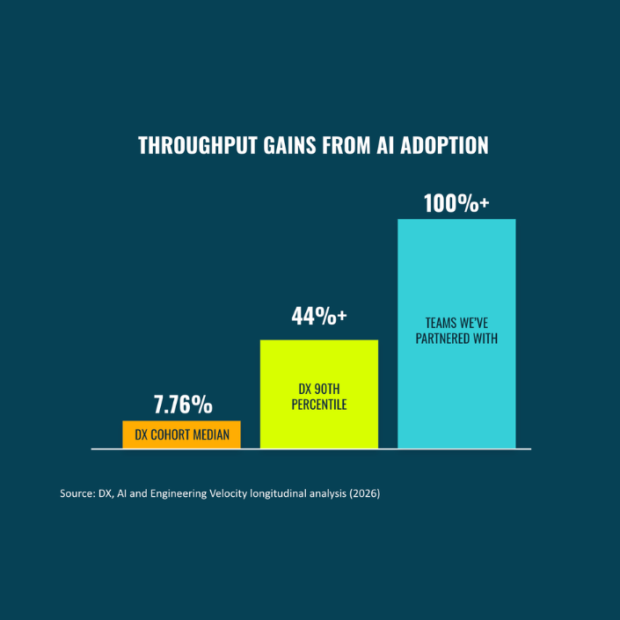
A 2026 report from DX ("AI and Engineering Velocity longitudinal analysis") found the median company saw only a 7.76% gain in throughput and the 90th-percentile band sat at 44%+.
The ITA Group team had 100%+ gains.